
How to Calculate the Average Basket Value of Your Fashion Store
Sommaire
Key Takeaways
- Average basket value = Revenue ÷ Number of transactions over a given period.
- The formula is the same for physical stores and e-commerce, but its interpretation differs depending on the sales channel.
- Cross-selling, up-selling, visual merchandising and staff training are the most direct ways to increase it.
- Many external factors, including seasonality, sales channel and market positioning, naturally influence changes in average basket value.
- A broad and regularly refreshed catalogue, combined with low minimum order requirements, makes it easier to diversify your product range and encourage complementary purchases in-store. Markdown collé
What Is Average Basket Value and Why Is It Important?
A Simple Definition
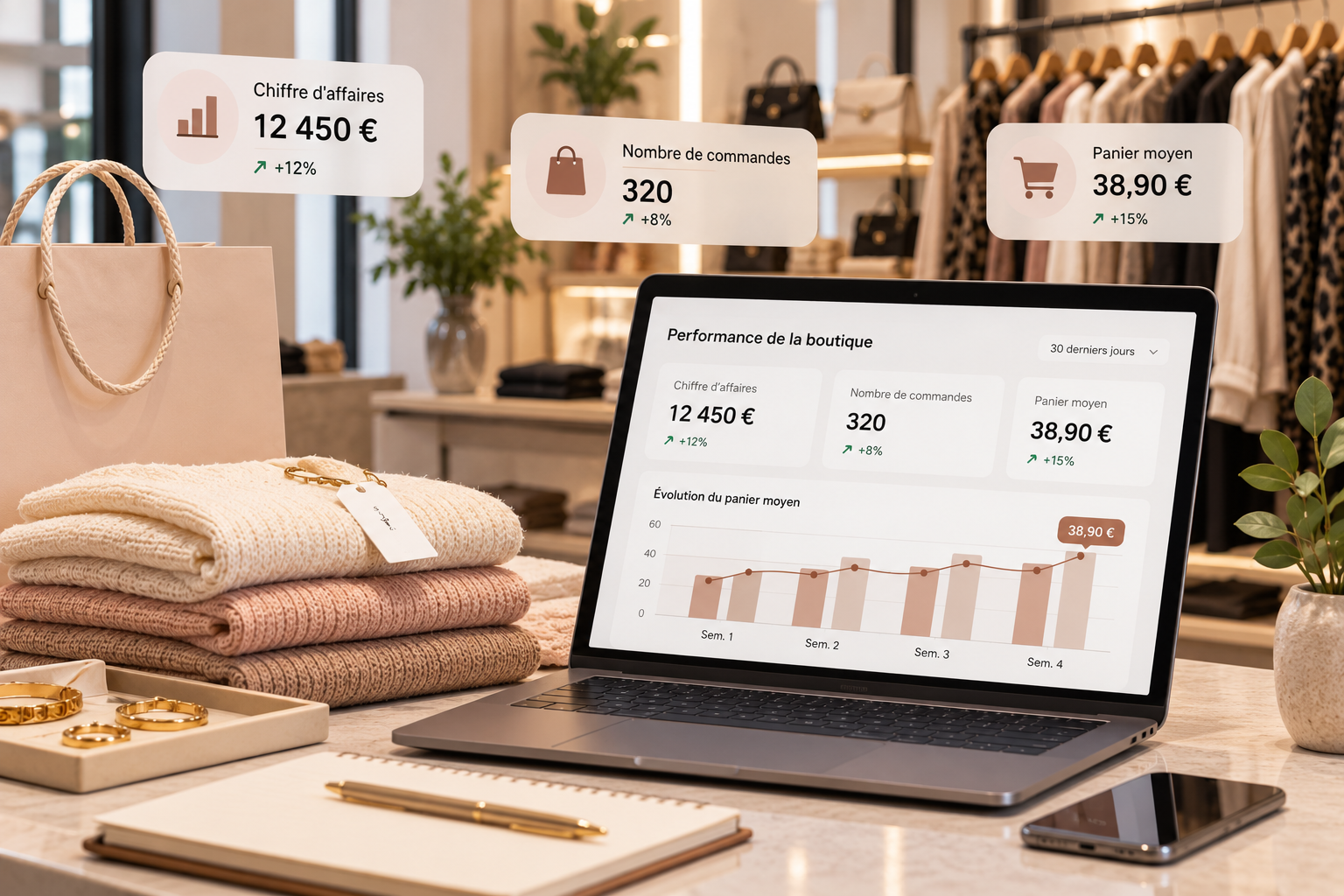
Average basket value, also known as average transaction value in a physical store, represents the average amount spent by a customer per transaction over a given period.
It answers a very practical question: on average, how much do your customers spend each time they check out or place an order? Markdown collé
Why This Metric Matters for Your Store
| What average basket value helps you do | Practical example |
|---|---|
| Measure the value of each transaction | Compare two sales periods |
| Track changes in purchasing habits | Identify a gradual decline in basket value |
| Compare several channels or points of sale | Physical store vs online store |
| Adjust pricing or promotional strategy | Test a free-shipping threshold |
On its own, average basket value does not tell you how many customers you have or how often they return. It should always be analysed alongside other indicators, such as the number of transactions or purchase frequency. Markdown collé
How to Calculate Average Basket Value Accurately
The Basic Formula
Average basket value = Revenue ÷ Number of transactions, over a given period.
| Data | Example |
|---|---|
| Revenue (month) | €10,000 |
| Number of transactions | 200 |
| Average basket value | €50 |
Physical Store or E-Commerce: The Same Formula, Different Interpretation
| Physical store | E-commerce site | |
|---|---|---|
| Number of transactions | Till receipts | Confirmed and paid orders |
| Data source | POS software, daily till report | Shopify, WooCommerce, PrestaShop dashboard |
| Key point to monitor | Allocate each sale to the correct period | Exclude cancelled or refunded orders |
In e-commerce, a common mistake is to include cancelled orders or failed payments in the calculation. This artificially lowers the average basket value. Markdown collé
Average Basket Value per Transaction or per Customer?
There are two approaches depending on the data available:
- Average basket value per transaction: Revenue ÷ number of receipts or orders. This is the simplest and most commonly used method.
- Average basket value per customer: Revenue ÷ number of unique customers, using loyalty programme or CRM data. This approach is useful if the same customer makes several purchases during the period being analysed.
If you have many regular customers who make several purchases during the same period, use the calculation per transaction to avoid distorting your analysis. Markdown collé
Common Mistakes to Avoid in This Calculation
| Mistake | Why it distorts the result |
|---|---|
| Including cancelled or refunded orders | Average basket value appears artificially lower |
| Comparing periods of different lengths | A sales month cannot be directly compared with a normal month |
| Ignoring VAT by mixing net and gross amounts | Comparisons between periods or channels become inaccurate |
| Analysing average basket value alone | You lose visibility on customer numbers and purchase frequency |
What Strategies Can Increase Average Basket Value?
Cross-Selling and Up-Selling
- Recommend a complementary product to the current purchase, such as a top to pair with a dress.
- Suggest a piece of fashion jewellery to complete an outfit.
- Highlight a higher-end version of a product through up-selling, using quality or finishing as the key selling point. Markdown collé
Visual Merchandising
- Display complete outfits rather than individual pieces.
- Place accessories close to key products.
- Create complementary sales areas near the checkout. Markdown collé
Staff Training
- Train your team to systematically suggest a complementary product.
- Encourage a simple sales approach, such as: “This piece pairs really well with…”
- Regularly monitor changes in average basket value to measure the team’s progress. Markdown collé
Promotions and Customer Loyalty
- Set a free-shipping threshold slightly above the current average basket value.
- Create bundles or packs at attractive prices.
- Introduce a loyalty programme that encourages customers to make more complete purchases during each visit. Markdown collé
How to Interpret Changes in Average Basket Value Over Time
Several factors can explain an increase or decrease in average basket value without necessarily indicating a problem:
| Factor | Possible impact |
|---|---|
| Seasonality, such as sales or the holiday period | Basket value may naturally rise or fall depending on the season |
| Sales channel, such as store, website or click & collect | Purchasing behaviour differs by channel |
| New arrivals or catalogue renewal | A refreshed catalogue encourages complementary purchases |
| General economic environment | Average basket value may fall independently of your commercial strategy |
An increase in average basket value caused solely by higher prices, without additional perceived value for the customer, should be monitored carefully. It may hide a decline in purchase frequency over the medium term.
Conversely, a stable average basket value combined with an increase in the number of transactions remains a positive signal for your store. Markdown collé
Diversify Your Product Range to Increase Average Basket Value Over Time
A Broad and Regularly Refreshed Catalogue
To offer more relevant product combinations, you need a sufficiently diversified catalogue covering dresses, tops, fashion jewellery and accessories.
However, working with multiple suppliers to cover every category requires significant management time for an independent retailer.
A B2B marketplace like Paris Fashion Shops allows you to:
- Access more than 1,000 brands and wholesalers from a single catalogue.
- Regularly discover new products to refresh your cross-selling opportunities.
- Quickly test new products thanks to low minimum order requirements, without tying up all your cash flow. Markdown collé
Frequent New Arrivals to Encourage Impulse Purchases
A catalogue that is regularly refreshed creates more opportunities to trigger an impulse purchase alongside the product already selected by the customer.
Thanks to consolidated orders and delivery within 24 to 48 hours, you can introduce these new products quickly without having to wait several weeks between restocks.
👉 Sign up now to access our full catalogue and diversify your product range to increase your average basket value over time. Markdown collé
A Metric to Monitor for Stronger Profitability
Calculating your average basket value regularly, rather than discovering it at the end of the season, allows you to quickly adjust your sales strategy and measure the real impact of each action you implement.
By offering a diversified and frequently refreshed catalogue with accessible minimum order requirements, Paris Fashion Shops helps you create more opportunities for complementary purchases during every customer visit.
Sign up today to discover our full catalogue and increase your average basket value over the long term. Markdown collé
FAQ
-
Average basket value represents the average amount spent by a customer per transaction.
It allows you to measure the value of each sale, track changes in purchasing habits and adjust your commercial strategy accordingly. Markdown collé
-
It is calculated by dividing the revenue generated over a given period by the number of transactions during the same period, whether these are till receipts in-store or confirmed online orders.
-
The most common mistakes are including cancelled or refunded orders, comparing periods of different lengths, and mixing amounts excluding VAT with amounts including VAT in the same calculation.
-
Cross-selling, up-selling, visual merchandising, staff training and bundled offers are among the most effective ways to increase the value of each transaction.